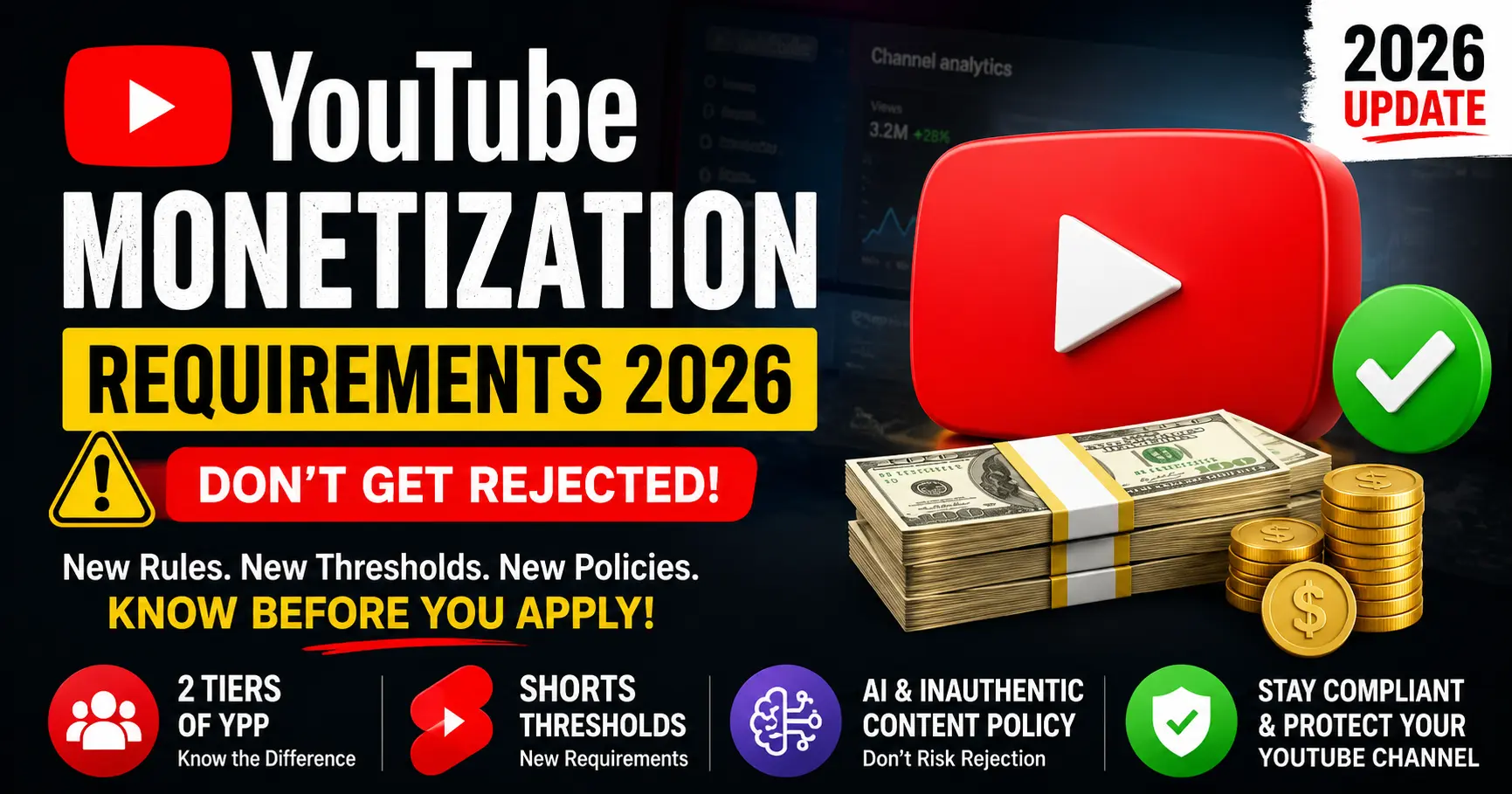
If you’ve been Googling “YouTube monetization requirements 2026” you’ve probably found a dozen articles that paste the same old checklist and call it a day. This isn’t that.
In this guide, we break down exactly what changed, what stayed the same, what the two tier system actually means for small creators, and what the new “inauthentic content” crackdown means for your channel right now. We’ll also show you how to check any channel’s monetization status instantly for free.
This article is a part of our complete YouTube Monetization for Beginners in India 2026 step by step guide
Table of Contents
The Quick Answer: YouTube Monetization Requirements 2026
There are now two tiers to the YouTube Partner Program (YPP). Here’s the fast version:
| Requirement | Tier 1 (Fan Funding) | Tier 2 (Full Ad Revenue) |
|---|---|---|
| Subscribers | 500 | 1,000 |
| Public videos (last 90 days) | 3 | No minimum |
| Watch hours (12 months) | 3,000 | 4,000 |
| OR Shorts views (90 days) | 3 million | 10 million |
| AdSense account | ✅ Required | ✅ Required |
| 2-step verification | ✅ Required | ✅ Required |
| Community Guidelines strikes | Zero active strikes | Zero active strikes |
| Eligible country | ✅ Required | ✅ Required |
What Tier 1 unlocks: Super Chats, Super Thanks, Super Stickers, Channel Memberships, YouTube Shopping affiliate. No ad revenue yet.
What Tier 2 unlocks: Everything above, plus full ad revenue sharing (55% on long-form, 45% on Shorts), and YouTube Premium revenue.
Now let’s get into what actually changed.
What Actually Changed from 2025 to 2026
Most creators asking this question want to know: is it harder or easier to get monetized now? The honest answer is: both, depending on what type of creator you are.
Here are the three real changes that matter:
1. The two-tier system is now the default
This wasn’t new in 2026 YouTube started rolling it out in 2023 but by 2026, the expanded Tier 1 (500 subscribers) is fully available across most eligible countries. If you haven’t heard about it, this is the biggest thing you’ve been missing. Smaller channels can now earn through fan funding features before hitting the 1,000-subscriber threshold.
2. “Repetitious content” was renamed to “inauthentic content” and it changed scope
On July 15, 2025, YouTube officially updated its monetization policy language. The policy formerly called “repetitious content” was renamed “inauthentic content” and expanded in scope. This change affects channels using mass produced, AI-generated, or low-effort content more broadly. We go into the full detail in its own section below it matters a lot.
3. AI content disclosure is now mandatory and enforced
If your content includes realistic synthetic or AI generated elements a voiceover, an AI reconstructed face, fake news style segments you must disclose it using YouTube Studio’s “Altered or synthetic content” toggle. YouTube began enforcing this in 2024 and tightened it further in 2026. Non-disclosure can result in demonetization or removal from YPP.
Tier 1 vs Tier 2: The Two-Door System Explained
Think of YouTube’s Partner Program like a club with two entrances. The first door is easier to unlock and gets you inside with limited access. The second door opens the full experience.
Tier 1: The Early Access Door (500 Subscribers)
To get through this door, you need:
- 500 subscribers (public or private both count)
- 3 public videos uploaded in the last 90 days
- 3,000 valid public watch hours in the past 12 months, or 3 million valid public Shorts views in the past 90 days
What you get: Super Chat, Super Stickers, Super Thanks (viewers can tip you during live streams and on videos), Channel Memberships, and YouTube Shopping affiliate access.
What you don’t get: ad revenue. That still requires Tier 2.
This tier is particularly valuable for creators who have a highly engaged, smaller audience. If your 600 subscribers are loyal fans willing to buy memberships or send Super Thanks during live streams, you can start generating real income before you hit 1,000 subs.
Tier 2: Full Monetization (1,000 Subscribers)
To earn from ads, you need:
- 1,000 subscribers
- 4,000 valid public watch hours in the past 12 months, or 10 million valid public Shorts views in the past 90 days
- A linked Google AdSense account
- 2-step verification enabled on your Google account
- No active Community Guidelines strikes
- Channel located in a YPP-eligible country (120+ countries as of 2026)
Once approved, YouTube pays you 55% of ad revenue on long-form videos and 45% of ad revenue on Shorts. You also earn a cut of YouTube Premium subscription fees when Premium members watch your content.
YouTube Shorts Monetization: A Completely Separate Path
This is where most creators get confused, and it’s important to get right.
Shorts watch time does not count toward the 4,000 hour requirement. Full stop. Even if your Shorts are racking up millions of views and hours of total watch time, none of it applies to the long-form watch hour threshold.
Shorts have their own completely separate eligibility path:
- Tier 1 (fan funding): 3 million valid public Shorts views in the past 90 days
- Tier 2 (full ad revenue): 10 million valid public Shorts views in the past 90 days
A channel that posts only Shorts and hits 10 million views in 90 days can qualify for full ad monetization without a single long-form video. Once approved, Shorts earnings come from a shared ad revenue pool YouTube takes out music licensing fees, then splits the remaining revenue, giving creators 45%.
One key phrase to understand: “valid public Shorts views.” Views from private videos, spam accounts, bots, or views generated through artificial means don’t count. YouTube audits these carefully at the application stage.
The “Inauthentic Content” Rule That’s Getting Channels Rejected
This is the single most important policy change you need to understand in 2026, and many creators aren’t aware of it until they get rejected.
Before July 15, 2025, YouTube called it “repetitious content.” The rename to “inauthentic content” wasn’t just cosmetic it expanded the definition of what qualifies.
What counts as inauthentic content?
According to YouTube’s official policy update, inauthentic content includes:
- Mass-produced content: videos that are clearly templated or auto-generated at scale
- AI-generated videos with no human value added: a voiceover over stock footage with no original commentary, perspective, or creativity
- Content that reads out other sources: videos that simply narrate Wikipedia articles, news stories, or other text without adding anything original
- Pitch or speed-modified songs: taking existing music and slightly altering it to avoid Content ID, then re uploading
- Recycled clips: reuploading other creators’ content, even with permission, without substantial original additions
What is still allowed?
YouTube’s Creator Liaison Rene Ritchie clarified that reaction videos, commentary, clips with original narration, compilations with original editorial framing, and educational content using clips are all still eligible as long as you’ve added significant original value.
The key question YouTube asks: does this content bring something new, or is it a copy of something that already exists?
If your content would give the viewer no reason to choose your video over watching the original source, it likely won’t pass the review.
AI Content and Monetization: What YouTube Allows in 2026
YouTube’s stance on AI content is more nuanced than the headlines suggest. The platform does not ban AI-generated content. It bans deceptive and low value AI generated content.
What YouTube allows
- Using AI to write, polish, or structure your script
- AI generated thumbnails
- AI tools for audio cleanup, noise removal, or enhancement
- AI dubbing into other languages (YouTube itself provides this)
- AI-assisted video editing
- Using AI for research, topic generation, or SEO optimization
- Voiceovers generated by AI as long as the content is original and disclosed
The distinction YouTube draws is assistance vs replacement. If you’re using AI to help you create something genuinely original, you’re fine. If AI is replacing the creative direction, editorial judgment, and originality entirely, that’s where you run into problems.
What gets you demonetized or rejected
- AI-generated fake news style videos with no human fact checking
- Deepfake videos where you haven’t clearly disclosed they’re synthetic
- Mass uploaded AI content with identical structure, just different keywords swapped in
- AI voiceovers on recycled clips from other platforms this is the combination that triggers the inauthentic content policy most often
The disclosure rule
If your video contains realistic synthetic content an AI generated face, an AI voice designed to sound like a real person, or AI reconstructed footage you must enable the “Altered or synthetic content” disclosure in YouTube Studio before publishing. This is mandatory and enforced. Missing it on a realistic AI segment isn’t a gray area anymore.
What Watch Hours Actually Count (Most Creators Get This Wrong)
The 4,000 watch hour requirement comes with conditions that aren’t always obvious.
Hours that count:
- Watch time on public long form videos
- Watch time from live streams (once the stream ends and is set to public)
- Watch time accumulated in the past 12 months
Hours that do not count:
- Shorts watch time (has a completely separate metric)
- Watch time on private or unlisted videos
- Watch time on deleted videos
- Watch time older than 12 months
- Watch time from spam or bot views
You can track your progress in YouTube Studio under Analytics → Overview → Watch time. The metric shown there is your total, so filter it to the last 365 days to see your eligible hours.
One often missed point: if you had 3,900 hours 13 months ago and barely posted since, those hours are rolling off your count. Watch hours are a rolling 12 month window, not a lifetime total.
Other Requirements You Can’t Ignore
Beyond subscribers and watch hours, YouTube checks several other factors during the review process.
Google AdSense account: You must create or link an existing AdSense account before applying. You can’t receive payments without one. If you already have an AdSense account from a blog or another YouTube channel, you can link the same one.
2-Step Verification: Your Google account must have two-step verification (2FA) enabled. This is a security requirement YouTube added to protect creator accounts and is a hard requirement your application won’t process without it.
Community Guidelines compliance: Zero active strikes. Even one active strike at the time of application is grounds for rejection. Expired strikes won’t block you, but active ones will.
Advertiser-friendly content: YouTube reviews whether your content is suitable for general advertiser placement. Consistently publishing content in restricted categories extreme violence, graphic content, controversial topics can result in rejection even if you technically meet the subscriber and watch hour thresholds.
Eligible country: YPP is available in 120+ countries as of 2026. If you’re in a country where YPP is not yet available, you cannot apply regardless of your metrics. Check YouTube’s official support page for the current country list.
Minimum 3 public videos (for Tier 1): You need at least 3 public videos uploaded in the last 90 days to qualify for the entry level tier. For Tier 2, there’s no minimum video count, but inactive channels take significantly longer to review.
How to Check If You’re Eligible Right Now
To check your own channel’s status:
- Go to YouTube Studio
- Click Monetization in the left menu
- You’ll see a progress tracker showing your subscriber count and watch hours against the thresholds
- If you meet all requirements, an Apply Now button will appear
Once you apply, YouTube’s review typically takes 1 to 4 weeks, though it can extend during high-volume periods. You’ll receive an email when the decision is made.
Want to check whether a competitor channel is already monetized? You can do that instantly and for free using Toolbil’s YouTube Monetization Checker. Enter any public channel name or URL and see its monetization status, estimated monthly earnings, CPM, subscriber count, and total views — no login required.
Common Reasons YouTube Rejects YPP Applications
Meeting the subscriber and watch hour numbers doesn’t guarantee approval. YouTube manually reviews your channel before accepting you. Here are the most common rejection reasons:
1. Inauthentic or repetitious content. If a reviewer looks at your channel and sees videos that are clearly mass-produced, AI-generated without original value, or recycled from other sources, you’ll be rejected under the inauthentic content policy even if you technically hit 1,000 subscribers.
2. Insufficient content for review. Channels with very few public videos make it hard for YouTube to assess quality and consistency. More content = faster, smoother review.
3. Community Guidelines violations. Even old violations that didn’t result in strikes can flag your channel during review if they signal a pattern.
4. Advertiser unfriendly content themes. Channels that primarily cover content in YouTube’s restricted categories (tobacco, gambling, dangerous activities, controversial topics) face heightened scrutiny.
5. Clickbait thumbnails or titles. YouTube actively checks whether your titles and thumbnails accurately represent your content. Systematic mismatch between thumbnails and actual video content is a red flag.
6. Linked AdSense account issues. If your AdSense account has been previously suspended or has outstanding policy violations, your YouTube application may be blocked until it’s resolved.
If you get rejected, YouTube provides a rejection reason and allows you to reapply after 30 days. Use that time to address the specific issue flagged in the rejection notice — not just your metrics.
How Much Does YouTube Pay After You’re Accepted?
Getting accepted is just the beginning. Here’s what the actual revenue looks like:
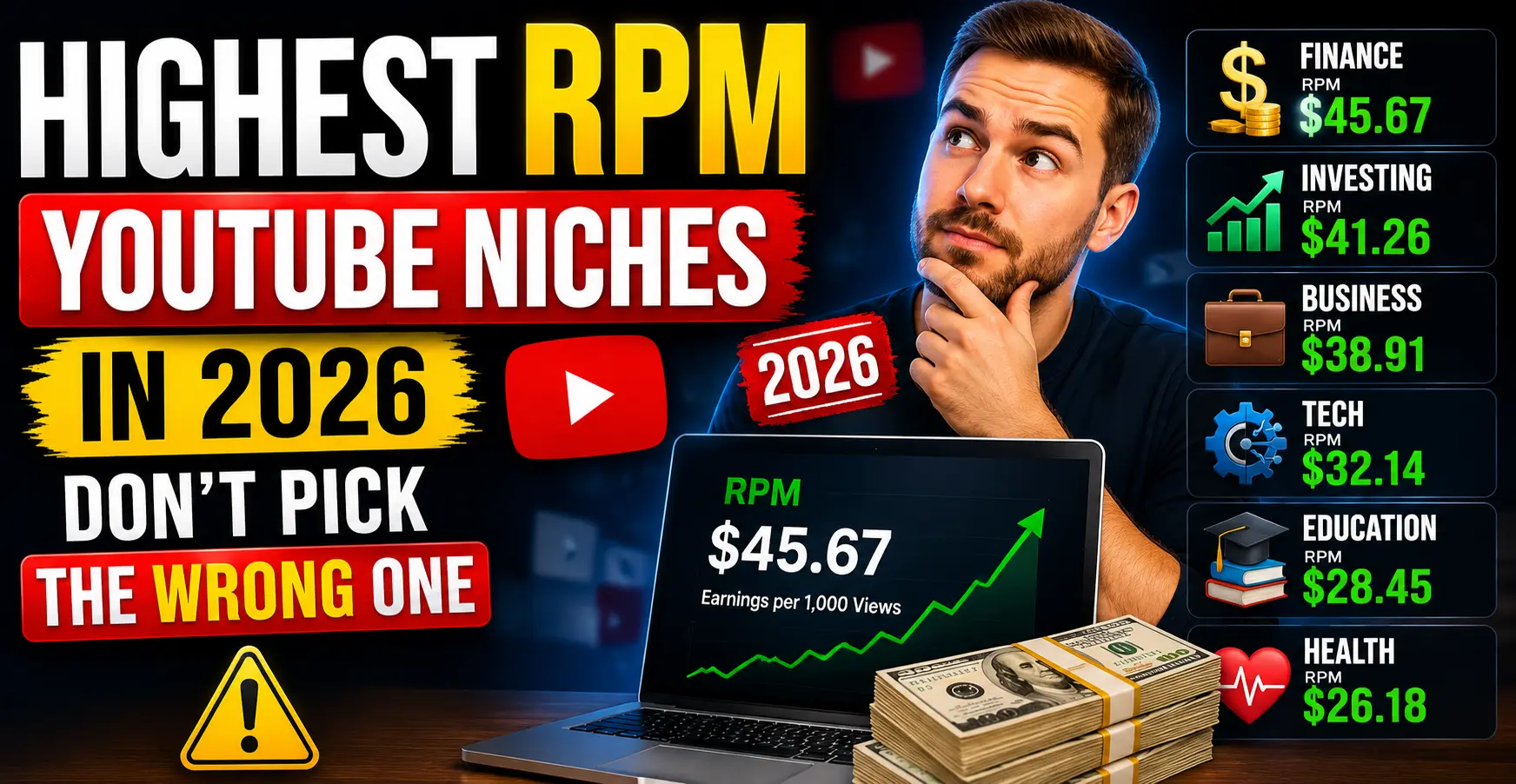
Long form videos: Creators keep 55% of ad revenue. RPM (revenue per 1,000 views) typically ranges from $1 to $10, depending heavily on niche and audience geography. Finance, tech, and business channels often see $8–$15 RPM, while entertainment and gaming channels typically see $1–$4.
Learn more about Highest RPM YouTube Niches in 2026
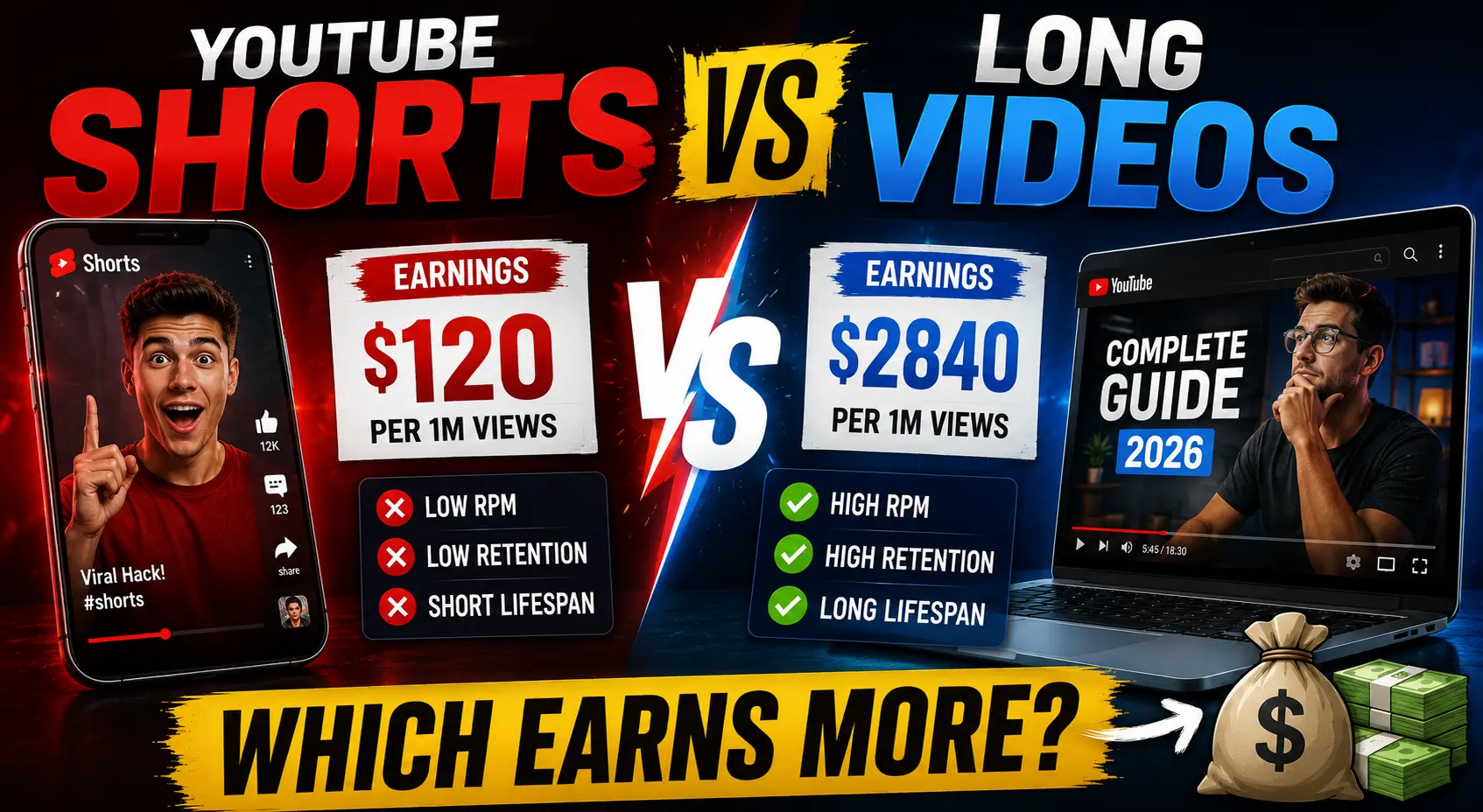
YouTube Shorts: Creators keep 45% of eligible ad revenue from the Shorts feed. Shorts RPM is generally lower than long-form because the ad format is less premium and the revenue pool is shared.
YouTube Premium: When a Premium subscriber watches your content, you receive a share of their subscription fee proportional to how much of their viewing time was spent on your channel.
Fan funding (Tier 1 features): Super Chats, Super Thanks, Super Stickers, and Channel Memberships pay out through AdSense. YouTube takes 30%, and you keep 70% of fan funding revenue.
Frequently Asked Questions
Does YouTube Shorts watch time count toward the 4,000-hour requirement ?
No. Shorts watch time has its own separate threshold (10 million Shorts views for full monetization). It does not contribute to the 4,000 long-form watch hours.
Can I monetize a YouTube channel in India or Pakistan in 2026?
Yes. Both India and Pakistan are YPP-eligible countries in 2026. You can apply as long as you meet all other requirements.
How long does the YouTube monetization review take?
Typically 1 to 4 weeks after you apply. Reviews can take longer during high-volume periods. YouTube sends an email once a decision is made.
Can I get monetized with only Shorts videos?
Yes. If you reach 1,000 subscribers and 10 million valid public Shorts views in 90 days, you qualify for full YPP without any long-form content.
What happens if I lose subscribers after I’m accepted?
Once accepted into YPP, you keep your monetization status even if your subscriber count drops below 1,000 — as long as you continue following YouTube’s policies and community guidelines.
Can AI-generated videos be monetized on YouTube in 2026?
Yes, if they contain original value and comply with disclosure requirements. Pure AI-generated content with no human creative input or original perspective is likely to fall under the inauthentic content policy and be rejected.
Is there a minimum number of videos required to apply?
For Tier 1 (fan funding), you need at least 3 public videos uploaded in the last 90 days. For Tier 2 (full ad revenue), there’s no official minimum, but inactive channels with very few videos take significantly longer to review.
What if my AdSense account was previously suspended?
A suspended AdSense account will block your ability to monetize. You’ll need to resolve the AdSense issue before YouTube can approve your application.
Summary: What You Need to Know in 2026
YouTube monetization in 2026 is more accessible than it used to be but it’s also more quality conscious than ever. The two tier system gives smaller channels a real on-ramp to earning, and Shorts now offer a legitimate fast track path. But the inauthentic content policy is being enforced more strictly, and AI content that doesn’t add genuine human value is being filtered out at the review stage.
The path to monetization is clear: build real content, add original perspective, disclose AI where required, stay within Community Guidelines, and hit either the long form or Shorts threshold. There’s no shortcut past the quality review.
To check where you stand right now or to check if any competitor channel is already monetized use Toolbil’s free YouTube Monetization Checker. No login. No cost. Instant results.
Sources: YouTube Help Center (channel monetization policies), YouTube Creator Academy, YouTube Partner Program official documentation, Rene Ritchie (YouTube Creator Liaison), reviewed and verified May 2026.

Shaurya K
Shaurya is a digital marketing strategist and YouTube growth consultant with over 10 years of experience working with content creators across gaming, lifestyle, finance, and education niches. They have helped 200+ YouTube channels land their first brand sponsorship and have managed influencer campaigns for both Fortune 500 companies and direct-to-consumer startups.